 All Posts
Cable insertion is a pretty hot topic these days for robotic manipulation. It immediately brings to mind new data centers, but it’s in fact ubiquitous across a much wider range of manufacturing domains, with numerous types of cables and connectors. Traditionally, it has also been considered a somewhat tricky robotics problem that requires selective compliance at the end-effector, and a good test of fine motor skills. So we trained a quick visuotactile policy to see how our stack handles cable insertion, using Ethernet as our connector of choice and the NIST Task Board slot.
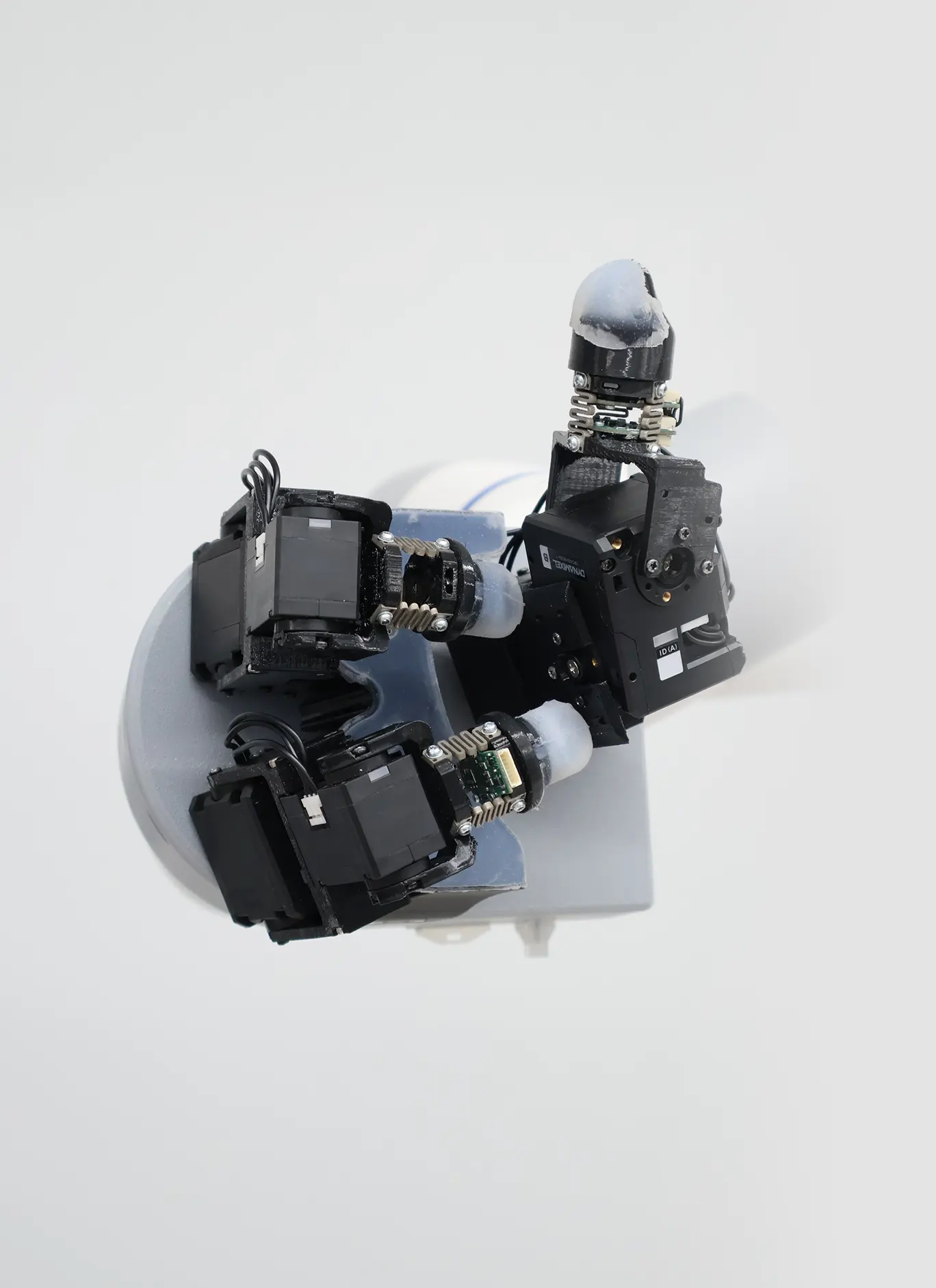
As expected, the policy learned to make extensive use of tactile data from the Popcorn sensor, reaching a 90% success rate (18/20) with touch data but falling to 10% (2/20) with vision only. With vision only, the policy still generally succeeds in picking up the cable but fails to plug it in, which is the part that requires fine motor skills. We also took advantage of another feature of the Popcorn, namely the ability to quickly and easily change fingertip shape and material properties: we used a slightly grooved TPU fingertip which fits the cable well for pickup and also has the requisite stiffness for insertion. We relied on our usual policy class, with shorter prediction and execution horizons (four and two steps respectively) to make it more reactive. This task did not leverage the high tip-to-tip dexterity of the TR01, and we did not spend a lot of time on task variation and robustness, but it was a good test of the hand’s touch sensing ability and its usefulness for this widespread problem class.